On-Premise Deployment
Qty | OS | Purpose | CPU | RAM | Storage | Additional Comments |
|---|---|---|---|---|---|---|
2 | Windows Server 2016 or later | Web Server (Review and AI) | 8 | 24GB | 200GB | IIS 10 or later, both behind a Load Balancer. |
1 | Windows Server 2016 or later | Database Server (Review) MSSQL 2016 STD or later | 24 | 192GB | 4TB | MSSQL 2016 or later, Standard or Enterprise Edition. |
1 | Windows Server 2016 or later | Database Server (Processing / AI) MSSQL 2016 STD or later | 24 | 192GB | 4TB | MSSQL 2016 or later, Standard or Enterprise Edition. |
1 | Windows Server or Unix/Linux with SMB/CIFS | Shared File Server (all solutions) | 8 | 16GB | 50TB | Can be an existing or new system with SMB storage. |
3 | Windows 10 x64 or Windows Server 2012 R2 or later | Processing Desktop Managers | 4 | 4GB | 150GB | |
10 | Windows 10 x64 or Windows Server 2012 R2 or later | Processing Agents | 8 | 8GB | 150GB | Fast, Local Storage highly recommended |
2 | Windows Server 2016 or later | Review Application Servers | 16 | 64GB | 300GB | |
6 | Windows Server 2016 or later (or Linux/Unix) | ElasticSearch Data Nodes | 4 | 48GB | 2TB | Fast, Local Storage highly recommended |
1 | Windows Server 2016 or later | Reveal AI Server + Caching Server | 8 | 128GB | 1TB | |
4 | Windows Server 2016 or later | Reveal AI Processing Server | 8 | 64GB | 200GB | |
1 | Linux 7.6 or later | Brainspace Web Server | 48 | 768GB | 19TB | |
1 | Linux 7.6 or later | Brainspace Build Server | 32 | 256GB | 16TB | |
1 | Linux 7.6 or later | Brainspace ODA Server | 32 | 256GB | 19TB |
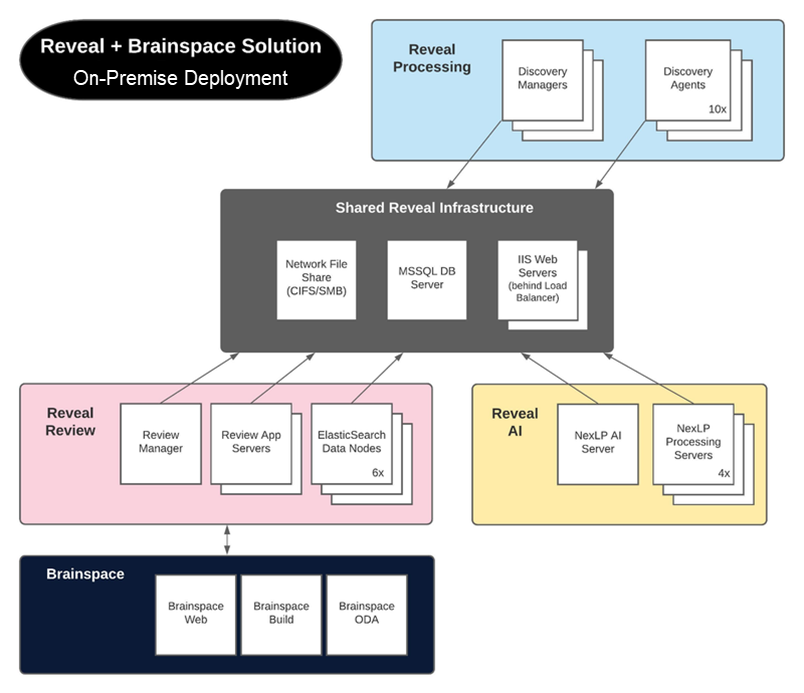 |
All components should reside on same subnet to minimize latency.
Optional AI NexBERT functionality is presumed to use Microsoft Azure Machine Learning service. On-premise deployments of NexBERT are supported.
Please keep in mind technical restrictions (Memory, CPU Cores, etc.) for Microsoft SQL Server editions when considering adjustments to the above recommendations; the Reveal solutions can each use separate MSSQL servers if that is beneficial from a budgetary standpoint.
Note
As servers are added, architecture and services change, causing sourcing on some servers to decrease from one deployment to another.